The Sauna World Championships: Your Finland Travel Guide
The Sauna World Championships ran in Heinola, Finland, from 1999 to 2010 and ended after a competitor died. Here is what the contest was and what replaced it.
On this page
The Sauna World Championships no longer exist. They were an annual endurance contest held in Heinola, a small town north-east of Helsinki, every year from 1999 to 2010, and they stopped for good after a competitor died in the 2010 final. Competitive sauna today looks nothing like that contest: it is Aufguss, a judged performance tradition staged inside ordinary public saunas.
The distinction matters for travellers because the two formats sit at opposite ends of sauna culture. Heinola rewarded the person who endured heat longest; Aufguss rewards a saunamaster who controls heat, scent and atmosphere for a seated audience. The contest is history. Aufguss is something you can book into on an ordinary evening in Germany, Norway or the Netherlands.
What the Sauna World Championships were
The championships were a sauna-sitting contest: competitors entered a hot room together and the last person to leave won. Twelve editions ran at Heinola between 1999 and 2010, growing out of informal sauna-sitting challenges into an international event with more than 130 participants in its final year.
What were the Sauna World Championships? They were an endurance contest held in Heinola, Finland, from 1999 to 2010, in which competitors sat in a sauna heated to 110C and the last person to leave won.
Why did the Sauna World Championships end? In the 2010 final, Russian competitor Vladimir Ladyzhenskiy died and Finnish champion Timo Kaukonen was hospitalised with burns. The event was suspended and then cancelled permanently by the organisers.
Where were the Sauna World Championships held? Every edition took place in Heinola, a town north-east of Helsinki. The contest did not tour, and the venue has hosted no successor endurance championship.
In its final years the contest drew competitors from outside Finland, including a strong Russian contingent, and the reigning champion was a Finn, Timo Kaukonen, who had won five times. That international field is part of why the 2010 events were reported well beyond Finland.
For a traveller researching Finnish bathing, the contest is a footnote rather than a tradition. Ordinary Finnish practice means short rounds in the heat, cooling off outdoors or in water, then going back in, which is the frame the Finnish sauna guide sets out.
How a championship round worked
The rules were deliberately harsh and simple. The sauna was heated to 110C, water was thrown on the stove every 30 seconds, and competitors had to signal a thumbs-up to judges when asked and be able to walk out unaided. Whoever stayed longest won.
Competitors had to present a doctor's certificate before taking part, and first-aid staff were on site, according to the organisers at the time. Those precautions are the detail worth remembering: the format was extreme by design, and it still went wrong.
Compare that with a normal session. Finnish custom is roughly 5 to 15 minutes per round, followed by cooling off and a rest, repeated a few times; how many saunas are in Finland explains how ordinary the practice is across the country. Nobody is timed, and leaving early is normal, not defeat.
The 2010 final and the end of the contest
In the 2010 final, Russian competitor Vladimir Ladyzhenskiy died after about six minutes in the 110C heat, and Timo Kaukonen was pulled out and hospitalised with burns. Judges intervened when they saw something was wrong; police were investigating the death at the time.
The event was suspended immediately and then cancelled permanently. Heinola city council's cultural secretary, Saija Jäppinen, said the competition was over and done, and officials confirmed it would not run again.
There is no successor endurance contest in Heinola. Any page advertising a modern sauna world championship for heat endurance is best read as a different event, usually an Aufguss competition, before you plan travel around it.
Why the format sat outside Finnish sauna tradition
Endurance sitting inverts the logic of the Finnish sauna. The point of a round is the cycle: heat, then cooling, then rest, with the cold option treated as part of the pleasure rather than a punishment. The avanto ice swimming in Finland guide describes how that cycle works with a hole in the ice, and it reads very differently from a contest clock.
The heat itself is normally a matter of preference. Finnish saunas commonly run somewhere between about 70C and 90C at head height, adjusted by throwing water on the stones, and regulars choose a bench level to match.
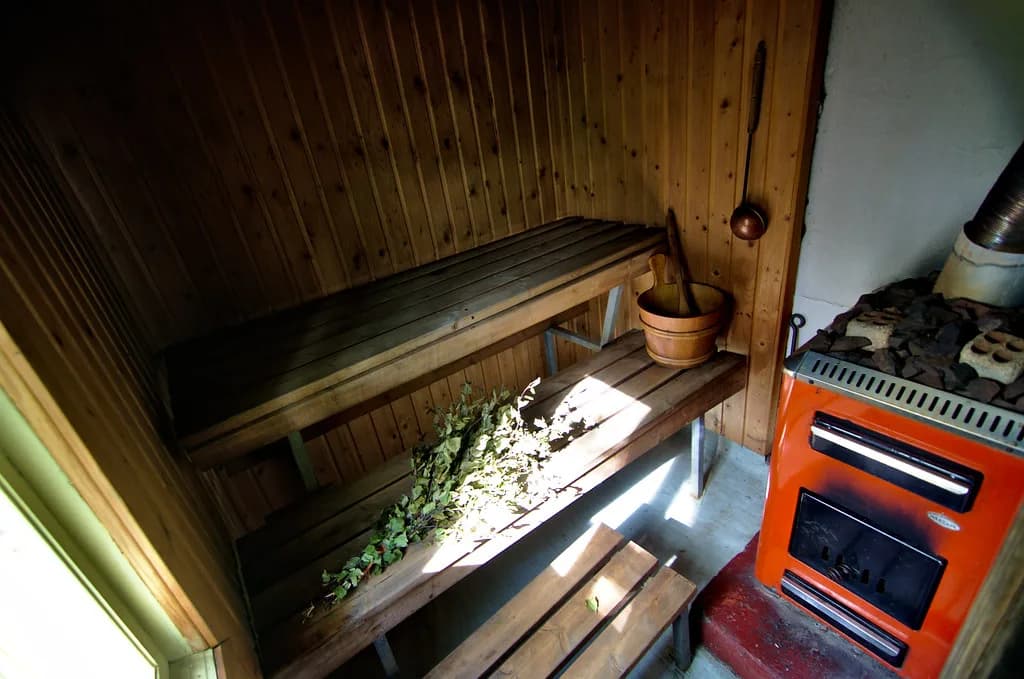
The equipment follows the same logic. The kiuas sauna stove and its stones are chosen to give a good Löyly, the steam that rises when water is thrown, not to hold a room at a punishing fixed level for a set number of minutes.
Travellers who want the deeper end of the tradition should look at savusauna, the smoke sauna, where the fire is lit hours ahead and the room is ventilated before bathers enter. Kuukkeli Saunaworld is one place to see the format presented for visitors.

What replaced it on the competitive calendar
Competitive sauna now means Aufguss. A saunamaster works the heat and air with a towel, adds scent to the water, and builds a short programme with music, lighting and sometimes choreography, performed for a seated audience inside a normal sauna cabin.
The world body runs two formats. Aufguss WM is the theatrical championship, where costumes and staging are part of the show. The Modern Classic Cup strips it back to music, essential oils and precise towel technique, judged on heat control, fragrance and rhythm.
In 2026 the two events ran at named venues rather than in a purpose-built contest hall: Aufguss WM took place from 14 to 20 September at Satama Sauna Resort & Spa in Germany, and the Modern Classic Cup from 1 to 4 October at Farris Bad in Norway. Jiří Žákovský won the Modern Classic Cup title, the second edition of that format.
The competition side grows out of national contests, so the same saunamasters appear in ordinary venues across Germany, the Netherlands and the Nordic countries. In Finland the Baltic and lakeside public saunas in Finland are where a visitor is most likely to meet a scheduled show session.
Watching or joining a show Aufguss
A show Aufguss is a performance for an audience, not a private ritual, so behave like a good spectator. Sit where the saunamaster indicates, keep conversation to a minimum, and leave between rounds rather than mid-programme if the heat is too much.
Expect to sweat far more than in a quiet session, because the saunamaster keeps adding water and moving air. A seat on a lower bench is a sensible choice for a first time, and a towel to sit on is standard in German and Dutch venues.
The whisk, or vihta, that some saunamasters use belongs to the same family of tools. The sauna whisk guide covers how birch bundles are made and used, which helps you read what is happening on the floor.
Etiquette and what to bring
Rules vary by country and venue: German and Dutch saunas are usually nude and mixed, while many Finnish public saunas have separate men's and women's shifts and some accept swimwear. Read the venue's own notice before you undress, and follow the Finnish sauna etiquette notes on showers, towels and seat covers.
Bring two towels, one to sit on and one to dry with, plus a water bottle and sandals for the walk between rooms. A Finnish sauna hat is optional, but it makes a long Aufguss programme more comfortable by softening the heat at head height.
Shower before your first round and again between rounds, and use the cold option only as you would on any other visit. In Finland a public venue usually runs on walk-in entry with a small fee, cash or card, and the locker and towel arrangement is posted at the counter.
Sauna safety, plainly stated
Stay hydrated, skip alcohol before bathing, and leave the room if you feel unwell; anyone with a heart condition or who is pregnant should ask a doctor about sauna use first. That is the whole of the advice here.
The Heinola contest is a warning about treating heat as a competition, not a template for the sauna evening. Nobody in a public sauna is measuring your minutes, and leaving early costs nothing.
Sauna Competitions for Spectators Travelling with a Dog
If you are travelling in Finland with a dog and want to watch competitive sauna rather than sit in one, the current calendar points to events outside Finland. The AUFGUSS WM took place on 14 – 20 September 2026 in Satama Sauna Resort & Spa, Germany, and the Modern Classic Cup took place on 1 – 4 October 2026 in Farris Bad, Norway. The Modern Classic Cup 2026 at Farris Bad was the second edition of the classic Aufguss championship, and it closed the 2026 season with 21 contenders, a jury and the Farris Bad team.
The two formats differ in what an audience watches. Show Aufguss is a performance-based sauna ritual that combines traditional heat and scent with storytelling, music, lighting, and choreography, performed by one or more saunamasters. The Modern Classic Cup returns to music, essential oils, and precise towel technique—without costumes, props, or theatrical effects—with solo rituals judged on heat control, fragrance composition, rhythm, and atmosphere.
For the older Finnish contest, the published record gives dates and a location rather than a dog policy: the World Sauna Championships were an annual endurance contest held in Heinola, Finland, from 1999 to 2010. The 2010 event was the 12th world sauna championships and had been held in Heinola, 86 miles north-east of Helsinki, since 1999; after the death of Vladimir Ladyzhenskiy, Heinola City Council announced the end of the event, and officials said the competition would not run again.
Planning a Sauna Trip Around the Old Contest
Heinola holds no endurance championship today, so there is no reason to travel there for one. If you are in the region, treat it as ordinary Finnish sauna country: book a normal public session, take a short round, cool off and repeat.
For the competitive side, follow the Aufguss calendar. The world body publishes its championship dates and results each season, and the transport is straightforward: both 2026 host venues are spa resorts reachable by train and road from their nearest cities. If you would rather watch show sessions on home ground, our Tampere sauna guide covers the public halls where Finnish Aufguss events are staged.
For a first Finnish sauna trip, start with a Helsinki public hall or a lakeside smoke sauna and learn the round-and-cool rhythm before you chase any show. The history of the sauna gives the long view, but the practice is learned in ten minutes by doing it.
Explore more Finland sauna guides
Frequently Asked Questions
What were the Sauna World Championships?
They were an endurance contest held in Heinola, Finland, from 1999 to 2010, in which competitors sat in a sauna heated to 110C and the last person to leave won.
Why did the Sauna World Championships end?
In the 2010 final, Russian competitor Vladimir Ladyzhenskiy died and Finnish champion Timo Kaukonen was hospitalised with burns. The event was suspended and then cancelled permanently by the organisers.
Where were the Sauna World Championships held?
Every edition took place in Heinola, a town north-east of Helsinki. The contest did not tour, and the venue has hosted no successor endurance championship.
Who won the Sauna World Championships?
Timo Kaukonen of Finland was a five-time winner and the reigning champion at the time of the 2010 final. The contest's final was never completed.
Is there a sauna world championship today?
Yes, but it is Aufguss, a judged performance format rather than an endurance contest. In 2026 the Aufguss WM ran from 14 to 20 September at Satama Sauna Resort & Spa in Germany and the Modern Classic Cup from 1 to 4 October at Farris Bad in Norway.
What is Aufguss and where can I see it?
Aufguss is a sauna ritual performed by a saunamaster using scent, towel work, music and sometimes choreography for a seated audience. It appears on the programme of public saunas and spa venues across Germany, the Netherlands and the Nordic countries, usually as a scheduled session in the evening.
Can I try the endurance format at my local sauna?
No, and it is not worth copying. Ordinary practice is short rounds of roughly 5 to 15 minutes with cooling off in between, and leaving the room early is completely normal.
What should I bring to a public sauna session?
Two towels, one to sit on, a water bottle, sandals and a change of clothes. Some venues supply towels and seat covers, and Finnish halls often sell or lend them at the counter.
Sources
Sauna notes for your next trip
Optional updates to our sauna guides.
You might also like

Continue reading
More guides you'll find useful